

Bridging system-level ambition and asset-level decisions with phased entry transition asset finance
Our previous article, Phased Energy Transition Asset Finance – A New Approach, highlighted a fundamental gap in the energy transition: the disconnect between system-level Net Zero ambitions and asset-level investment decisions.
While national, regional and global energy pathways establish the scale and timing of required emissions reductions, there remains a need for a practical framework that bridges these ambitions with the technical, economic, financial and market realities facing individual asset owners, developers and investors.
Whether developing a new energy asset or transitioning an existing fossil-based asset, the Phased Energy Transition Asset Finance framework offers an alternative approach. Rather than treating decarbonisation as an immediate, binary replacement of fossil-based infrastructure with entirely new clean-energy assets, it considers the asset as a managed and financeable transition over its economic life.
This approach recognises that the transition of energy assets is influenced by multiple interdependent considerations:
The timing and extent of fossil-fuel input reduction and substitution with renewable or low-carbon alternatives.
Equipment compatibility, operational safety and technical constraints associated with changing energy and molecule inputs.
Equipment degradation, remaining useful life and the impact of different operating regimes.
CAPEX and OPEX implications, including the timing of maintenance, retrofit, replacement and repurposing investments.
Cash-flow implications and the ability of the asset to support additional investment and debt servicing.
Financing structures, investment returns and risk allocation.
Carbon reduction and the environmental benefits associated with each transition phase.
The asset's overall transition trajectory and contribution to wider Net Zero objectives.
These considerations require more than conventional project appraisal or individual optimisation models. They require an integrated decision framework capable of assessing and optimising multiple variables simultaneously, providing developers, investors and financiers with the evidence needed to make informed asset transition and financing decisions.
AI-Enabled Asset Transition Lifecycle Decision Model
Artificial Intelligence (AI), supported by digital technologies and asset digital twins, provides an opportunity to make this transition pathway dynamic, evidence-based and continuously adaptable.
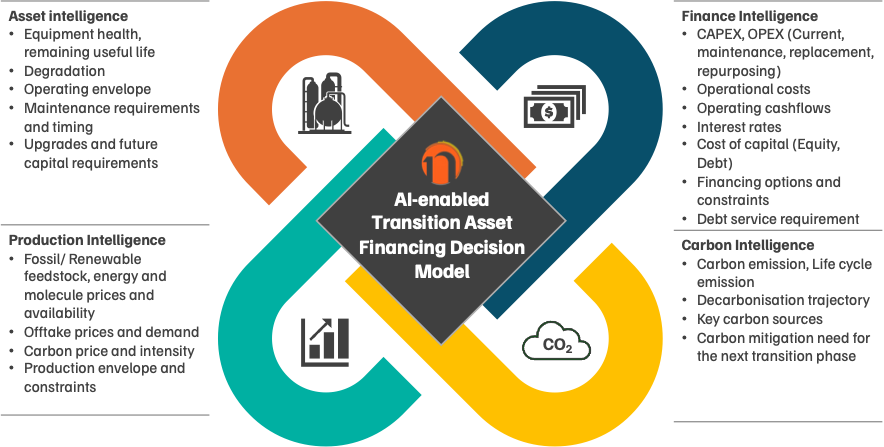
An AI-Enabled Asset Lifecycle Transition Decision Model brings together four interconnected intelligence vectors: production, asset, financial and carbon intelligence to develop a commercially viable asset development plan with phased transition towards net zero with pre-defined constraints.
Production intelligence :
Determines the optimum production strategy and energy/molecule mix, taking into consideration fossil and low-carbon resource availability, renewable energy generation, electricity and fuel prices, feedstock costs, offtake prices, demand and carbon intensity. AI can evaluate alternative operating scenarios and determine when, and to what extent, renewable energy and low-carbon molecules should progressively substitute fossil-based inputs, while maintaining production requirements, operational reliability and commercial viability.
Asset Intelligence :
Assesses asset health, equipment degradation, remaining useful life, operational constraints and maintenance requirements. Predictive analytics can identify potential failures, optimise maintenance interventions and assess the impact of changing operating conditions and energy inputs on equipment integrity.
Importantly, this intelligence connects operational decisions with future maintenance and capital requirements, enabling asset owners to optimise operating performance and extend useful asset life without compromising safety or accelerating degradation
Finance intelligence :
Evaluates the investment requirements and financial viability of alternative transition pathways, including initial and future CAPEX, OPEX, maintenance and replacement costs, repurposing requirements, production availability, revenue, energy and feedstock prices, interest rates and financing structures.
The model can assess cash flows, NPV, IRR, debt-service capacity and financing requirements under different market and operating scenarios. This allows developers and financiers to evaluate the timing and scale of capital deployment and identify appropriate financing pathways for each transition phase, rather than relying on a single upfront investment assumption
Carbon intelligence :
Measures the asset's carbon footprint and tracks its progressive decarbonisation trajectory. By connecting energy and molecule inputs, production performance, equipment efficiency, maintenance, replacement and lifecycle emissions, the model can quantify the carbon intensity and emissions reduction associated with each transition phase.
This ensures that each investment decision has a measurable carbon outcome and that the cumulative asset-level transition remains aligned with its intended Net Zero pathway. Compliance with the most up to date regional or national level regulations can be verified as well in parallel to ensure applicable changes are built into the decision making process.
The proposed model provides developers, investors and financiers with the ability to test alternative transition pathways, transition speeds and financing structures before FID, for both new assets and existing assets seeking to progressively transition towards Net Zero. Importantly, the framework does not end at FID.
The assumptions and decisions established during the pre-FID assessment can become the baseline against which actual asset performance is continuously measured and validated throughout the asset lifecycle.
As the asset enters operation and progresses through each planned transition phase, real-world data can be fed back into the AI-enabled decision model to compare base case assumptions with actual performance, identify variance to update forecast and revise transition and financing decisions. This creates a continuous plan–operate–validate–learn–invest cycle.
Key consideration here is capital phasing with a defined carbon reduction, asset integrity outcome, economic returns, financing requirements while supporting overall transition. Effectively turning decarbonisation into an investment staircase rather than a single financing cliff.
Where actual performance is better than the original assumptions, the model may identify an opportunity to accelerate the next transition phase or bring forward additional capital deployment. Conversely, where performance, market conditions or asset integrity deteriorate, the model can identify the need to defer, modify or restructure the next investment phase while maintaining the overall transition trajectory.
This creates a significant distinction from conventional project development, where the business case is largely established before FID and subsequently managed against a relatively fixed plan.
The opportunity with AI-enabled decision model
AI/Digital tools provides the opportunity to make that pathway dynamic and evidence-based. It can connect production economics, asset health, carbon performance, market conditions and financing into one continuously evolving decision model. The model offers flexibility for accelerating asset transition plan based on market, infrastructure, technology and supply chain maturity advances without compromising overall decarbonisation goals.
For developers, this provides a mechanism to test and optimise development strategies before committing significant capital. For investors and financiers, it offers greater visibility of future capital requirements, asset performance, cash flows and transition risks. For policymakers, it provides a potential means of connecting system-level decarbonisation targets with the investment decisions and actual performance of individual assets.
Ultimately, the aggregation of credible asset-level transition pathways can provide a more tangible basis for assessing progress towards sectoral, regional and national Net Zero objectives.
Concluding perspective: AI as enabler of phased energy transition finance
Achieving Net Zero requires a fundamental rethink of how the transition of energy assets is planned, evaluated and financed. Phased Energy Transition Asset Finance provides the investment architecture for this change. It defines how the transition should progress. AI, however, plays a distinct but complementary role. It provides the intelligence needed to make this financing architecture work in practice. AI helps determine how, when and under what conditions that transition should progress.
Nevertheless, AI should not be viewed as a solution in itself. Its recommendations are only as reliable as the quality of the underlying data, assumptions and models. Poor data, inappropriate optimisation or excessive reliance on automated outputs could create false confidence, reinforce investment biases or delay necessary decarbonisation decisions. Engineering expertise, financial discipline, independent validation, transparent governance and clear regulatory direction must remain fundamental. In particular, AI must not become a justification for prolonging fossil-fuel dependency without credible and enforceable transition commitments.
Used responsibly, the combination of these two concepts offers a more practical and potentially more effective approach to achieving Net Zero.
