

Phased Energy Transition Asset Finance - A New Approach
From Net Zero Ambition to Bankable Asset-Level Transition
Global, regional and national energy strategies increasingly seek to reduce fossil-fuel dependence and achieve Net Zero by 2050. Policy, regulation, incentives and public funding have consequently encouraged industries to develop new low-carbon and renewable-energy projects.
However, much of prevailing policy and investment architecture implicitly assumes a binary transition from fossil-based asset to new clean energy asset. This is particularly evident in the development of new clean and low-carbon fuel production assets.
Many new low carbon or clean energy fuels asset require substantial greenfield CAPEX, new infrastructure, new feedstock supply chains, new offtake agreements, supporting infrastructure, OEM capacity and long-term price certainty. Where the resulting green premium cannot be absorbed by the end consumer, or where consumers do not have sufficient willingness or ability to pay, the project may fail to achieve bankability. The result can be a gap between Policy ambition, project development, to bankability and FID and ultimate net zero outcome.
Significant development effort and capital can therefore be expended without producing a corresponding decarbonisation outcome. The risk is that repeated failure to reach FID discourages further investment, slows technology and supply-chain development and, paradoxically, encourages capital to return to more established conventional energy investments
Bridging system-level ambition and asset-level decisions
There appears to be a gap whereby market participants are trying to deliver system-level net zero goals with asset level investment decisions without a clear bridging framework that enables evaluation of technical, economic, financial and market forces at the asset level to achieve not only commercially and financially viable asset / project development but also provides confidence of achieving system level ((national, regional, global) NetZero goals.
A different way of thinking about the transition
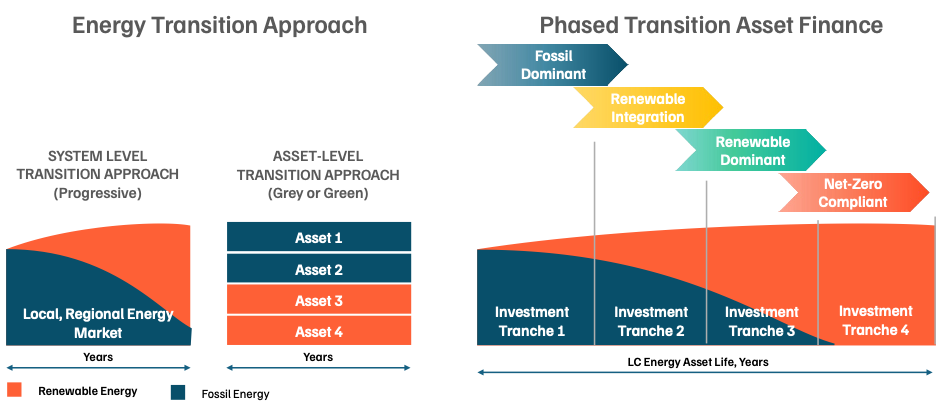
The situation requires adopting an alternative approach for assets where immediate conversion from fossil-based operation to fully renewable or clean-energy operation is commercially or financially challenging, the alternative should not necessarily be to abandon the transition. Instead, the asset can be treated as a managed, financeable transition asset over its economic life
Such transition can be from fossil-dominant to hybrid (fossil-clean energy source) towards renewable or clean energy dominant asset leading eventually to a NetZero compliant asset. This approach recognises that technology, infrastructure, supply chains, markets and financing capacity do not mature simultaneously. Capital can therefore be deployed progressively as the economics and enabling ecosystem to develop.
The objective is not to preserve fossil dependence. It is to create a credible bridge from today's economically viable asset to tomorrow's Net Zero asset, with predefined transition milestones, carbon outcomes, asset-integrity requirements and financing conditions. In effect, decarbonisation becomes an investment staircase rather than a single financing cliff.
Phased Transition Asset finance
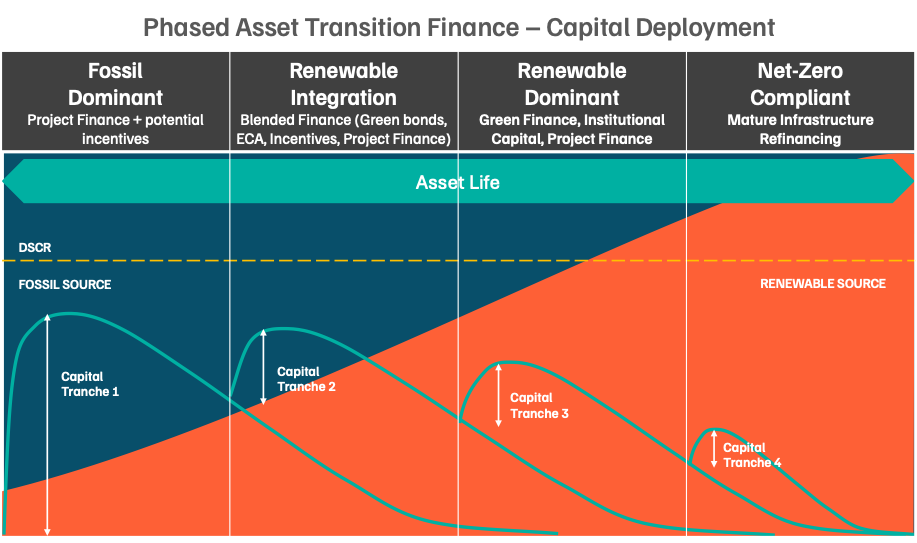
The approach creates an opportunity for a new financing architecture. Rather than financing the entire future transition upfront, capital can be linked to verified transition milestones linked to overall energy efficiency, carbon intensity, hybridisation targets, clean energy substitution, eventual clean energy dominant and net-zero compliance. Financing covenants could incorporate KPIs and requirements for each of these parameters as well as meeting required qualifications for maintaining allocated public grants or incentives bringing alignment between developers, asset owners, financiers, policy makers and community through measurable outcomes.
“ Energy Market Participants should aim to translate NetZero ambition into bankable transition pathways, where every tranche of capital has a defined economic impact and measurable carbon consequence ”
Opportunity with the proposed approach: Creating an ecosystem not fragmented assets or projects
Improved bankability: Progressive CAPEX reduces initial investment hurdle and allows project to demonstrate performance before committing the next capital tranche. Covenants and requirements for the financing to deliver to the proposed transition ensures commitment from both developers and fanciers to commit to the transition goals.
Create supporting infrastructure demand with sustained and structured development: a predictable transition pipeline creates definitive demand for the supply chain enabling such asset development such as feedstock, renewable electricity, molecules (hydrogen, carbon), storage, pipeline, logistics, OEM capacity and maintenance services to evolve
Moderate new-energy price shocks: gradual demand growth can allow supply chain and infrastructure to scale progressively rather than forcing simultaneous large-scale deployment
Improve effectiveness of public funding: Public funds will be utilised more effectively for the concrete delivery of decarbonisation and transition linked development rather than locking in such supports to projects and developments that may not progress beyond FID
It can be argued that such proposition has multiple risks associated with asset/ project bankability which needs careful assessment and management.
Transition delay – There is a potential that such phased asset development model can be utilised as an excuse to maintain fossil dominance. Such risk can be managed with performance linked finance with binding carbon trajectories, transition milestones, fossil-use limits and public funding support
Additional debt burden, capital requirement uncertainty – There is a potential of future clean energy price, feedstock or clean molecule price, OEM and infrastructure capacity maturity and market maturity impacting future revenue and cash flow. Uncertainty about potential future capital requirement or additional debt burden can be a red flag to the financier looking for ensuring debt service cover through the cash flow generated by the asset.
CAPEX gates, refinancing triggers, scenario analysis and appropriate risk-sharing mechanisms are potential mitigations. Contract for difference, floor-price mechanisms, carbon contracts, govt backed guarantees, production incentives or long-term offtake agreements and blended finance are some of the market mechanisms providing additional protection against such risks.
Technology lock-in: Hybrid system could become stranded if the future technology develops faster than expected. Design for flexibility, modularity, repurposing, OEM contractual provisions and transition readiness-assessment from the concept stage are crucial risk mitigation techniques. Scenario planning with future optionality could provide additional assurance prior to FID
The energy transition may not fail to deliver to its end goal because the technologies are unavailable; it may fail because the pathway from technology ambition to investable asset is insufficiently structured. If Net Zero is ultimately delivered through millions of asset-level decisions, then the decisive innovation may not be another technology—it may be the ability to translate Net Zero ambition into bankable transition pathways, where every tranche of capital has a defined economic purpose, asset-integrity outcome and measurable carbon consequence
