

From FOAK project to scalable Platform: Rethinking Value Creation and the Rise of the Portfolio Developer in low-carbon economy
The low-carbon energy market is entering an important transition. The industry has moved beyond proving that individual technologies and first-of-a-kind (FOAK) projects can work. The next challenge is to build credible, scalable and repeatable projects at commercial scale, while simultaneously addressing energy security and the transition to a lower-carbon energy system. For new entrants, this creates both an opportunity and a strategic dilemma.
A successful first project is essential for establishing credibility. But it should not be viewed as the destination. Developers should explore how their first project can create the capabilities, relationships, references and market position required to build a repeatable portfolio with easier, cheaper, faster and more valuable projects. That shift — from project success to repeatable value creation — is at the heart of the emerging portfolio developer model.
The first project establishes credibility. The portfolio creates resilience. The platform creates scalability. And capital recycling can turn development expertise into a much larger business. This is the emerging strategic logic for new developers in low-carbon energy.
The developer becomes the orchestrator
Low-carbon projects involve multiple participants, each capturing value at different points across the project lifecycle. A useful way of understanding this is through the DEBOOT model — Design, Engineering, Build, Own, Operate and Transfer — and by examining where each participant captures returns, risk premium, intellectual property value, margin or strategic advantage.
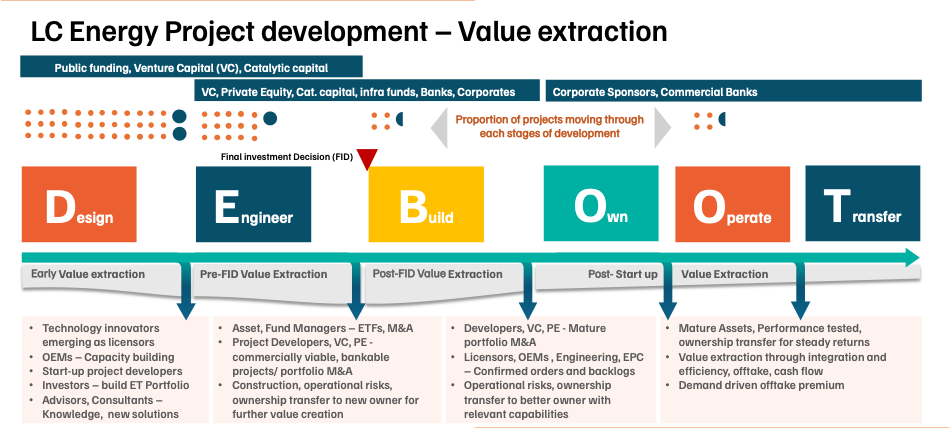
Importantly, value is not distributed evenly across the lifecycle. Earlier stages generally involve higher development risk, but can also create significant value uplift as uncertainty is progressively removed. Later stages tend to involve lower development risk and more predictable cash generation.
For the developer, this creates a fundamental opportunity: turn a conceptual opportunity into a permitted, contracted and financeable asset. That value can subsequently be captured by retaining the asset, partnering with an infrastructure investor, or selling the de-risked project at a higher valuation. But developers are not the only participants evolving their business models.
Licensors: converting intellectual property into repeatable commercial value
Technology providers can create value without owning the underlying project. Research grants and other forms of public or catalytic funding can help move a technology from research proposition towards commercial deployment. The strategic objective is then to embed the technology early — often through demonstration-scale projects — establish a reference base and create a pathway towards commercial-scale deployment.
Their business model evolves and the critical asset is therefore translate technology into bankable and repeatable commercial projects.
OEMs: from equipment sales to installed-base economics
OEMs are similarly moving beyond the initial equipment sale. Grants, innovation funds and partnerships with developers can support product demonstration and early market adoption. Once equipment is deployed at scale, the installed base creates an opportunity for recurring value through, Operations and maintenance, Spare parts, replacement, upgrades and performance optimisation.
For equipment with a 15–30 year operating life, the installed base can become a strategic asset in its own right. This creates an important incentive: an OEM may prioritise design-in and installed-base growth, even where the initial equipment margin is constrained, because the longer-term aftermarket opportunity can be significant.
EPC contractors: monetising execution capability
EPC contractors create value by converting designs into functioning assets. Their economics are fundamentally different from those of developers or technology licensors because the EPC contractor typically assumes significant schedule, cost, interface and performance risks in exchange for its margin. Consequently, risk allocation becomes central to the EPC business model.
The opportunity extends beyond the initial construction contract into commissioning, operations and maintenance, and future brownfield modifications. Over time, execution experience can become a source of competitive advantage as contractors develop repeatable processes, supply-chain relationships and project-specific expertise.
Corporates and industrial offtakers: optimising the project and the downstream economics
For corporates and industrial offtakers, value creation arise from combining a project view to a broader industrial systems adopting an integrated approach combining, Energy or feedstock security, Operational efficiency, Low-carbon product premiums, Demand-led commercial opportunities, Access to subsidies and incentives, Integration with existing industrial assets.
Portfolio thinking: the next source of competitive advantage
The biggest strategic lesson from the investment community is the importance of portfolio construction. Infrastructure funds, institutional investors, venture capital and private equity each participate at different points on the risk/reward spectrum. Rather than relying on a single asset, investors can balance exposures across different technologies, contractual structures, development stages and risk profiles.
The scale of capital flowing into the sector reinforces the importance of portfolio thinking. According to PwC, the energy and utilities sector has typically seen around $600–700 billion of Energy and Utility M&A activity annually over the past decade, while annual investment is projected to increase by 76% to approximately $1.1 trillion by 2050. Recent years have also seen a growing number of large-scale transactions involving global investors including BlackRock, Brookfield, KKR, Blackstone, Temasek, leading investment banks and major Norwegian and Canadian pension funds.
The energy transition offers opportunities across a wide spectrum of risk and return. Institutional investors therefore manage exposure through portfolio construction rather than relying on a single asset or technology. A blended portfolio can combine regulated electricity networks, contracted renewables and selected merchant or storage exposure to balance predictable cash generation with higher-growth or higher-risk opportunities. Large infrastructure investors increasingly extend this logic through platform and buy-and-build strategies: acquiring or developing a group of assets around a common operating model, consolidating capabilities, creating scale efficiencies and building a larger investable platform.
Investors are already thinking in portfolios. Developers increasingly need to do the same.
Individual low-carbon projects often have asymmetric risk. Some projects will be delayed, restructured or fail to reach FID, while a smaller number of successful projects can generate disproportionate returns. Successful first project is essential, but to become a successful developer, it is not essential assume that every project will reach FID. Instead, capital should be allocated progressively as projects pass increasingly demanding technical, commercial, regulatory and financial hurdles.
The low-carbon energy market is likely to reward companies that can do more than execute individual projects. Developers who can repeatedly originate, de-risk, finance, build, operate and replicate projects while retaining the highest-value portions of the economics shifts the basis of competition from project ownership towards position ownership.
The business model should evolve from Project-by-project participation to Portfolio-based risk management and repeatable value capture. This does not mean pursuing diversification for its own sake, but to balance risk-adjusted returns with sufficient concentration to build expertise, scale and a defensible market position.
Five pathways for new developers
The portfolio model also changes how new developers can enter the market. There is no single entry model. Different approaches can be appropriate depending on the developer's capabilities, capital base and access to scarce resources.
1. Early-stage developer
The developer secures access to a potential development site, establishes the project concept, progresses permitting and offtake, and ultimately monetises the development. This approach can require less capital than owning and constructing the project, but carries significant development risk.
2. Co-developer
A new entrant can partner with an incumbent developer while contributing a specialist capability. This provides an opportunity to acquire project experience, market references and relationships while sharing development risk.
3. Developer + corporate JV
A partnership with an industrial corporate can be particularly powerful where the corporate brings an existing site, energy demand, feedstock or downstream product market. The developer contributes project-development capability while the corporate can provide demand certainty and strategic integration. The resulting proposition can potentially improve the bankability and economic efficiency of the project.
4. Developer + technology provider
Where technology providers need a route to market, a developer can become the commercialisation partner. This model can be particularly relevant to demonstration-scale projects where grants or public funding help reduce the financial exposure associated with early technology deployment.The developer provides project origination and commercialisation capability; the technology provider contributes differentiated intellectual property and technical capability.
5. Platform developer
The most scalable model is to develop multiple projects around a standardised development model.For developers with prior experience of developing and scaling businesses, and with appropriate venture, private-equity or fund backing, this can provide a pathway from individual project development to a platform business.
It’s important to highlight that partnerships become a competitive weapon in this space through out the project and portfolio building journey.
Mantra is to control what is scarce
For a new entrant, the most attractive opportunity is not necessarily where the largest capital expenditure sits. It may instead be where there is something scarce, difficult to replicate and strategically important to project development. That could be, development sites, grid or infrastructure access, technology or intellectual property, feedstock, long-term supply arrangements, offtake, customer relationships, permitting capability or local market knowledge.
The first successful project can create much more than project-level financial returns. It can establish reference credentials, technology and execution expertise, customer and off taker relationships, investor confidence, future financing access, supplier relationships and perhaps also repeatable project architecture for the portfolio scale. The first project therefore becomes an institutional asset: it demonstrates that the developer can take an opportunity from concept through development and ultimately to commercial operation.
Over time, the developer’s competitive advantage becomes less dependent on any individual project and more dependent on the system it has built to repeatedly create projects.
The emerging low-carbon business model
The strategic evolution of business model is from project development to pipeline development and progressing ultimately towards portfolio and platform development.
At the platform stage, development processes become standardised, capabilities become repeatable, projects can be replicated, capital can be recycled and institutional investors can participate at scale. The platform is not simply a collection of projects. It is a repeatable system for originating, developing, financing, executing and scaling projects. That represents a shift from project ownership to position ownership. Importantly, reaching the platform stage is not the only viable outcome. A high-quality specialist developer can create significant value by developing projects and selling them to larger capital providers.
The strategic choice is to decide which part of the value chain to own, which capabilities to build, and which scarce position to control. End of the day, success belongs to developers who do not optimise only for the success of the first project, they optimise for what the first project makes possible.
If it creates credibility, relationships, capabilities, financing access, technology learning, customer access and a repeatable development model, the first project can become the foundation of a portfolio. And the portfolio can become the platform from which a much larger business is built. This is where the developer model begins to converge with the investment model: both are ultimately seeking to allocate capital across a portfolio of opportunities while building a position that compounds in value over time.
