

The Bankability equation of e-Fuels: Aligning Power, Offtake and Commercial Viability
Almost 50% of e-fuel production operating costs can be associated with renewable power. Renewable electricity is also fundamental to producing hydrogen and e-fuels that qualify under clean-fuel criteria, such as RFNBO or equivalent regional frameworks. Compliance with these criteria can determine access to premium offtake markets and, ultimately, the cash flow available to service project debt. Lenders are therefore not simply underwriting the electrolyser, synthesis plant or renewable generation asset individually; they are underwriting a chain of linked risks across the entire project.
PPA and Offtake Contract Alignment for Bankability
Power purchase and product offtake contract structures can have a substantial impact on the overall bankability of an e-fuels project. However, their individual characteristics are less important than how the two contracts are aligned across price, volume, tenor, intermittency and balancing, certification, operational and counterparty risks.
E-fuel bankability is fundamentally a question of contractual risk allocation and cash-flow matching. A project becomes more financeable when the PPA, balancing arrangements, certification framework and e-fuel offtake collectively convert volatile renewable power and emerging-product-market risks into sufficiently predictable long-term cash flows.
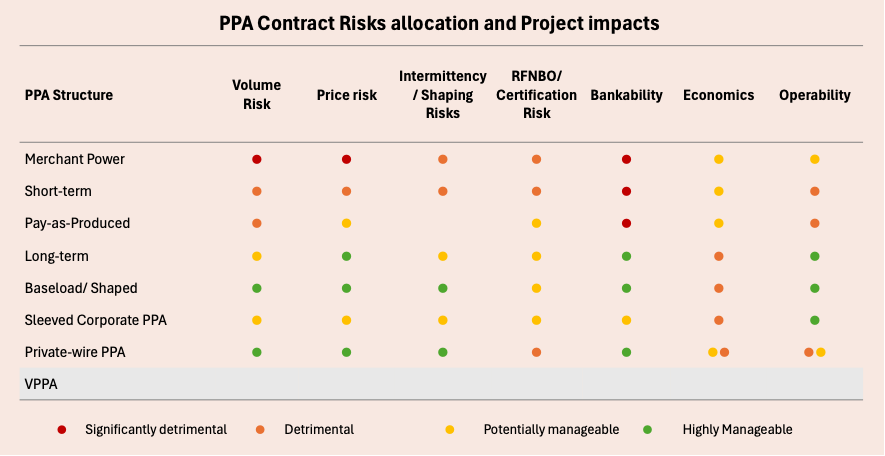
Power Purchase Agreements
Under a pay-as-produced PPA, the e-fuel producer purchases whatever renewable electricity the generation asset produces. This leaves the project exposed to both price and volume risk associated with the renewable resource. The intermittent power profile can also be difficult to accommodate within an e-fuel production facility, particularly where the electrolyser, hydrogen system and synthesis plant have minimum operating loads or turndown constraints. Additional balancing, storage or backup power may therefore be required to stabilise operations. Depending on the structure, this can affect certification, economics, operability, or all three.
A baseload or shaped PPA provides greater volume and profile certainty and can therefore improve bankability. However, achieving a stable supply profile generally requires firming intermittent renewable generation through other qualified technologies, such as hydro or battery energy storage systems. For projects targeting EU RFNBO markets, the contractual structure must also accommodate applicable additionality, temporal and geographical correlation requirements. Regulatory and certification bankability therefore becomes an important consideration for lenders alongside conventional credit and contractual risks.
Greater certainty over power volume and shape generally comes at a price premium, which can materially affect project economics. Shorter-term PPAs, for example contracts of up to five years, can provide greater flexibility and potentially allow the project to renegotiate power prices as the market develops, but they may leave lenders exposed to refinancing or merchant-price risk after the initial contract period. Long-term PPAs, potentially extending to 15 years or more, can provide stronger visibility over operating costs and support debt sizing, but can also lock the project into power prices that may subsequently become uncompetitive.
A private-wire or behind-the-meter PPA can provide a different approach. It may allow the project to directly integrate renewable generation with the e-fuel facility and can potentially be structured to support regulatory compliance and minimum operating requirements. A combination of direct renewable supply, firming and controlled turndown could help sustain critical plant operations during periods of low renewable generation. This can reduce certain pricing and supply risks, although it introduces additional operational, maintenance and interface complexity. Where renewable generation exceeds facility requirements, excess electricity may potentially be exported to the grid and sold into the spot market, although this introduces additional commercial and balancing considerations.
A virtual PPA, by contrast, does not provide physical electricity to the e-fuel facility. Its value is primarily contractual and environmental, potentially providing renewable or low-carbon attributes that may be recognised in certain markets. Its suitability for an e-fuel project therefore depends heavily on the applicable regulatory framework. A VPPA does not, by itself, solve the physical electricity, intermittency or operational requirements of the production facility, and its usefulness for qualifying the resulting e-fuel must be assessed on a market-by-market basis.
Overall, PPA structures affect three interconnected dimensions of the project: bankability, economics and operability. A PPA that maximises certainty may improve debt capacity but impose a significant cost premium, while a lower-cost structure may leave the project exposed to risks that lenders cannot comfortably underwrite.
E-Fuel Offtake Contracts
E-fuel offtake contracts are equally important. The combination of the PPA and offtake agreement ultimately determines how effectively the project converts volatile power costs and production uncertainty into predictable cash flow.
One of the most important considerations is tenor alignment.
For example, a 15-year PPA supporting an e-fuel production facility with only five years of take-or-pay offtake provides five years of contracted revenue against 15 years of contractual power costs. The project therefore has substantial residual exposure after the offtake expires, potentially creating merchant-price, refinancing and volume risks.
From a lender's perspective, closer alignment between the PPA tenor, offtake tenor and debt tenor generally provides greater cash-flow visibility and therefore stronger bankability. However, this certainty comes at a cost. Long-term contractual commitments can reduce the project's ability to capture future improvements in power procurement, technology costs or e-fuel market pricing.
Fixed-Price Offtake
A fixed-price offtake provides a high degree of revenue certainty but does not necessarily provide margin certainty. The project's exposure depends on the relationship between the fixed e-fuel selling price and the cost of electricity and other variable inputs.
A fixed product price combined with merchant or inadequately hedged electricity can simply transfer volatility from the revenue side to the margin side. The lender therefore needs to assess not only whether revenue is contracted, but whether the resulting project margin remains sufficient under realistic power-price scenarios.
Given the premium currently associated with e-fuels, securing a long-term fixed-price offtake may be difficult unless the offtaker has a strategic interest in developing the project or securing long-term supply. For conventional project-finance lenders, this can create a significant residual market and margin risk.
Indexed Offtake
An indexed offtake can provide greater flexibility by linking the product price to one or more underlying variables, such as electricity prices, carbon prices or an agreed green premium. This can improve the project's economic resilience by sharing certain market risks between producer and offtaker.
However, every additional pricing component introduces another variable for lenders to underwrite. The bankability of the index therefore depends on its transparency, liquidity, predictability and contractual definition.
This is particularly relevant for e-fuels because the market for long-term indexed pricing remains relatively immature. An index that appears economically rational may nevertheless be difficult for a lender to treat as a reliable source of debt-service cash flow if there is insufficient market depth or price history.
CfD and Government-Supported Mechanisms
Where an e-fuel project can benefit from a Contract for Difference (CfD) or equivalent government-supported mechanism, there is potentially a stronger route towards project-finance bankability. Such mechanisms can help manage product-price risk while potentially allowing the PPA and offtake tenors to be aligned more closely with the debt structure.
The critical question, however, becomes the overall combination of contractual arrangements:
What combination of PPA and offtake structures minimises project cash-flow risk without transferring so much risk to contractual counterparties that the resulting cost makes the e-fuel uncompetitive?
This is ultimately the central commercial optimisation problem.
From Bankability to Commercial Viability
Alignment of PPA and offtake contracts can materially improve bankability, but contractual alignment alone cannot solve every challenge facing an e-fuel project.
Sponsors and developers may need to consider the wider project architecture, including:
SPV structure and allocation of risks between project participants;
strength, creditworthiness and strategic commitment of SPV sponsors;
integration of renewable generation, hydrogen production and e-fuel synthesis;
proximity to the ultimate end-use market;
opportunities for asset integration and shared infrastructure;
blended finance and government-supported capital;
alternative equity and debt structures across different project-development stages;
staged financing through development, construction, commissioning and ramp-up; and
mechanisms to manage residual merchant and regulatory risks.
These considerations can be particularly important where conventional project finance is difficult to apply during the early stages of market development. A project may therefore require different sources and structures of capital as it progresses from development through construction and into operations.
Ultimately, bankability and commercial viability are related but distinct questions. PPA and offtake alignment can improve the predictability of project cash flows and reduce the risks that lenders are required to assume. It cannot, however, eliminate the underlying cost of renewable power, intermittency, certification, technology performance or emerging-market demand.
